Facebook Account Blocked Due to Alleged Child Sexual Exploitation – What to Do if You Are a Victim of a System Error?
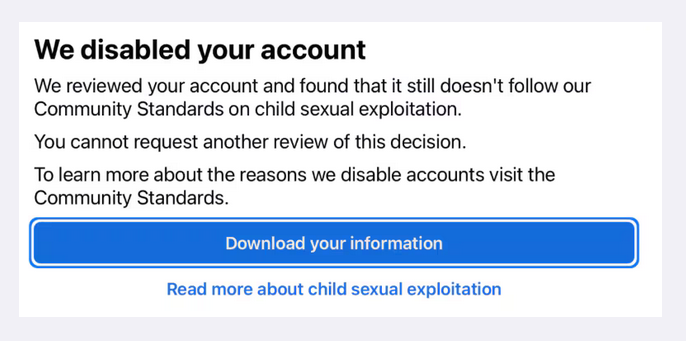
You receive an unexpected message:
We disabled your account
We reviewed your account and found that it still doesn’t follow our Community Standards on child sexual exploitation.
You cannot request another review of this decision.
To learn more about the reason we disable accounts visit the Community Standards.
This is one of the most shocking messages you can see on your screen. It appears suddenly, without warning and without explanation, affecting not only access to your account but also your reputation.
For most people, such a notification is a shock—especially if they have never published or shared any illegal content. Yet Facebook automatically blocks accounts, often permanently, without giving a real opportunity to respond. In an instant, you lose access not only to your profile but also to messages, contacts, groups, fan pages, and tools that may be essential for professional or personal life.
In my legal practice, I have seen many people in exactly this situation. Initially, they feel helpless, fearful, and unfairly treated—how can you defend yourself against such a serious accusation when you are not even told what content caused it? In many cases, however, it turns out that the block was the result of an automated system error or account takeover, not an actual violation.
In this article, I will explain why Facebook makes such drastic decisions, how to recognize if a block might be a mistake, and what steps you can—and should—take to defend your reputation and regain access to your account.
Why Are Such Serious Accusations Made Immediately?
Facebook applies extremely strict rules regarding content related to child sexual exploitation—which is understandable. Protecting minors is a priority for the platform, and any suspicion in this area is treated as high-risk.
The problem is that, in practice, the vast majority of decisions are made automatically. Facebook operates on a global scale, relying on algorithms and AI systems designed to detect potentially prohibited content quickly. These systems analyze images, words, context, and sometimes user reports. However, they cannot always correctly assess intention, cultural context, or the actual nature of the content.
As a result, an account may be blocked almost immediately, without prior warning and without a real opportunity to explain the situation. The user does not receive information about which specific content was considered a violation or under what circumstances. Overnight, they lose access to their profile, friends list, messages, groups, fan pages, and often business contacts and tools used for work.
Furthermore, in cases of alleged child sexual exploitation, Facebook automatically blocks the creation of new accounts. This means that even if the block was due to a system error or third-party action, the user faces an effective, indefinite ban from the platform.
These consequences make the accusation—even completely unfounded—devastating. It impacts not only account access but also reputation, social relationships, and professional safety. For many, this is a real disaster both personally and professionally, especially when Facebook is an important communication, marketing, or work tool.
Why Does a Block Happen? Three Possible Scenarios
1. Account Taken Over by a Third Party (Most Common)
The first possible scenario is that the account was taken over by someone else—through hacking, phishing, or clicking on a fake login link. This happens much more often than one might think.
After the takeover, the account may be used to post content violating Facebook’s rules without the owner’s knowledge. When such content is posted, algorithms respond very quickly, and often the account is blocked almost immediately.
Sometimes friends notice suspicious posts and inform the owner via phone or other messaging apps. However, in practice, the block happens so fast that no one sees the irregular activity, and the user has no clue what caused it.
It is worth emphasizing that Facebook does not check whether the content was posted by the hacker or the account owner. From the system’s perspective, only the fact that prohibited activity occurred from that profile matters.
In such cases, standard „appeal” options usually do not work. Facebook confirms the user’s identity but still considers the account in violation, resulting in permanent deactivation.
Regaining access in this situation often requires legal action. In my cases, login history, suspicious activity data, and evidence of account takeover have often helped demonstrate that prohibited content was posted by third parties, enabling account recovery.
2. Automated System Error (Very Common)
In practice, for most people seeking help, account blocks result not from actual violations but from automated system errors. Facebook’s algorithms analyze enormous amounts of data—posts, comments, images, even private messages sent via Messenger—in near real time.
The problem is that these systems cannot understand context or intention—they cannot distinguish irony or emotional expressions from actual threats. They operate solely based on statistical correlations of words, phrases, and images that might indicate potential violations in other contexts.
As a result, errors are frequent. For example, a neutral or emotional message containing words associated with children or sexual content may be flagged as a violation:
“Because of this jerk, kids can’t go on vacation because he blew all the money at the bar with his friends.”
A human understands the meaning, but the algorithm reacts only to word proximity and statistical patterns. Such detections can lead to immediate account blocks, even though the content violates no rules.
Sometimes, blocks occur even without any content related to children or sexual material. This shows how common and erroneous automated decisions can be.
This scenario is the most common and also the most reversible—properly prepared actions (formal appeals, account history analysis, context clarification) often allow users to regain access, despite the initial „algorithmic verdict.”
3. Posting Potentially Prohibited Content (Least Common)
The last, rarest scenario is when content is knowingly or unknowingly posted that Facebook may classify as violating community standards. This usually involves visual materials, particularly:
Photos of young children (e.g., at the beach, bathing, or private situations),
Erotic material involving people whose age cannot be definitively verified as adult.
Though rare, these posts remain a real source of risk. Assessment depends on the content, context, and presentation. If a violation truly occurred, the block is justified; in doubtful cases, careful analysis is required to determine whether the decision was proportional and consistent with platform rules.
What to Do If You Know It’s a Mistake
Stay calm. You are not guilty of this accusation!
Check your account:
Was it hacked? Suspicious logins or unusual activity may indicate an account takeover.
Could any post, comment, or message have been misclassified by automated systems? Even artistic, educational, or satirical images may trigger algorithmic flags.
In such cases, consulting someone experienced in Facebook account recovery is valuable to determine realistic options.
How I Can Help
As a legal advisor, I represent clients who have fallen victim to unjust Facebook account blocks. I submit formal legal requests to Meta and represent clients before the platform’s legal team.
My experience shows that proper handling can realistically restore accounts even in challenging cases.
Between 2025–2026, I handled dozens of cases where clients’ accounts were unjustly blocked. Due to confidentiality, I do not publish the accounts accused of child exploitation—but here are examples of other accounts recovered through legal actions:
- Warsaw Boxing School Fanpage Recovery
- Love Montessori Fanpage Recovery
- MidRushCrew Case
- Company Fanpage Recovery
These cases demonstrate the variety of situations that can be resolved and how legal actions can restore account access, even long after a block.
Legal Costs and How to Apply
Legal assistance fees are determined individually, taking into account the specifics of the case, its complexity, and the amount of work required. For this reason, there is no fixed price list for account recovery services.
Billing model and price range:
In most cases, legal costs are divided into two parts:
Initial fee – covers case analysis, establishment of power of attorney, preparation and submission of documents, and representation before Meta by a legal advisor. This fee ranges from 350 euros for less complex cases to 600 euros for more complex cases.
Success fee – payable only after the account has been successfully recovered. If the account is not recovered, which is extremely rare, this part of the fee is not charged. The amount of the success fee is determined individually, but it is usually similar to the initial fee.
In practice, the total cost of legal assistance typically ranges from 700 euros to 1,200 euros, depending on the specifics of the case.
For a personal quote, use the contact form and provide:
- Date of account block,
- Screenshot of the block message,
- Details of suspicious actions indicating possible hacking,
- Any content that may have been misinterpreted as violating nudity rules.
We will determine the steps to help recover your account.
FAQ – Facebook Account Blocked for Alleged Child Exploitation
Why did Facebook block my account without warning?
Automated detection systems flag violations immediately, even if content was posted by third parties or due to a system error.Can I recover my account if blocked by mistake?
Yes. Many blocks result from system errors or account takeover. Professional legal assistance and login history analysis often prove the account did not violate rules.What does “You cannot request a review of this decision” mean?
The platform’s internal appeal procedure has already been conducted and rejected. Legal action or professional representation is needed to restore access.How could my account be blocked if I never posted prohibited content?
Account takeover by hackers,
Algorithm errors misclassifying neutral content,
Rare unintentional violations (e.g., private photos of children).
What should I check after a block?
Suspicious logins and activity,
Content potentially misclassified by algorithms,
Any other person with access.
Can legal help really restore a blocked account?
Yes. Legal actions can prompt Meta to review login history and content misclassified by the system. Many accounts were successfully recovered in 2025–2026.How do I apply for help?
Submit the contact form including:
- Block date,
- Screenshot of block,
- Suspicious activity or hacking attempts,
- Content that may have been misinterpreted as violating nudity rules.