Facebook Disabled Your Account for Violating the “Who Can Use Facebook” Rules? A Lawyer May Be Able to Help
“We disabled your account.” For many Facebook users, this message means losing access not only to their personal profile, messages and photos, but also to business contacts, Facebook Pages, advertising accounts and other assets connected to their account.
The situation can be particularly confusing when Facebook says that the account violated its rules concerning who can use Facebook, even though the user has had the account for many years and has always used their real identity.
In some cases, an account may have been compromised before it was disabled. An unauthorized person may have changed information associated with the account, including the date of birth. This can potentially result in Meta’s systems treating the account as though the user does not meet the requirements for using Facebook, including the minimum age requirement.
Importantly, even if Facebook displays the message “You cannot request another review of this decision”, this does not necessarily mean that there are no further ways to challenge the decision. Depending on the circumstances, other procedures may still be available, including legal action.
Facebook disabled my account – “who can use Facebook” violation
Some users receive the following message:
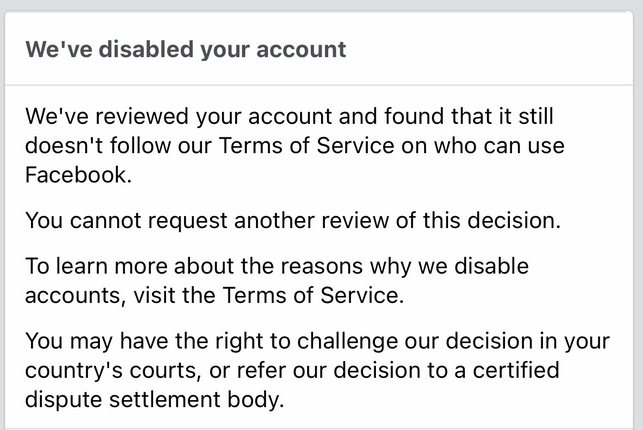
“We disabled your account. We reviewed your account and found that it still doesn’t follow our Terms of Service on who can use Facebook. You cannot request another review of this decision. To learn more about the reasons whe we disable accounts, vist the Terms of Service. You may have the right to challange our decision in your country’s courts, or refer our decision to a certified dispute settlement body”
The message is particularly problematic because it gives the impression that the matter has come to an absolute end.
Publicly documented cases show that users have received this exact type of message even when they claim that they did not knowingly violate Facebook’s rules. In some cases, users have also reported that an appeal appeared to have been processed even though they had not personally submitted one.
There are also documented cases in which Meta disabled accounts under the “who can use Facebook” category. Platform Actions, a public-interest database documenting platform enforcement actions, records several 2026 Meta account-disable cases citing this particular part of Facebook’s Terms of Service.
This means that the message should not automatically be interpreted as proof that the account holder actually failed to meet Facebook’s requirements.
What does “who can use Facebook” actually mean?
The “Who can use Facebook” section of Facebook’s Terms of Service sets out basic requirements for using the service.
Among other things, Facebook requires users to:
- use the name they use in everyday life;
- provide accurate information about themselves;
- create only one personal account;
- not share their password or give other people access to their account.
Facebook also states that people cannot use the service if, among other circumstances:
- they are under 13 years old;
- Facebook has previously disabled their account for certain violations;
- applicable law prohibits them from receiving Meta’s products or services.
These requirements mean that the phrase “who can use Facebook” covers more than age alone. A restriction under this category does not necessarily mean that Facebook has determined that the user is under 13.
The relevant requirements are set out in Facebook’s Terms of Service.
Can a hacked Facebook account lead to this type of restriction?
Yes, this is one possible scenario that should be investigated.
For example, the sequence may look like this:
- A hacker gains access to the Facebook account.
- The hacker changes information associated with the account.
- Meta’s systems detect activity or information that appears inconsistent with the platform’s requirements.
- The account is suspended or disabled.
- The legitimate account holder loses access and may no longer be able to use the ordinary appeal procedure.
One particularly relevant example was reported by a user in 2026 who said that their account had been compromised and subsequently disabled for an alleged age-related violation. The user reported suspicious logins and an unexpected age-verification process in the account data. This is an individual user report, rather than independent confirmation by Meta, but it illustrates why unauthorized access should be investigated when a “who can use Facebook” restriction appears unexpectedly.
Other users have described a similar sequence in which an account was compromised, an appeal appeared to have been submitted without their knowledge, and the account was subsequently permanently disabled.
Facebook rejected my ID – can I still recover my account?
A rejected identity document does not necessarily mean that an account can never be recovered.
One potential problem is that the information currently associated with the account may no longer correspond to the account holder’s actual information. This can be particularly relevant if the account was compromised before the identity verification process.
For example, if someone changed the date of birth or other account information before the account was disabled, Meta’s systems may be assessing the account on the basis of information that the legitimate owner did not provide.
This is why an account recovery case may require more than simply submitting an identity document. It may also be necessary to explain how the incorrect information appeared on the account and what happened before the restriction was imposed.
Facebook says I cannot request another review. What can I do?
Many users assume that the message “You cannot request another review of this decision” means that the account is permanently beyond recovery.
In practice, the message means that the standard review process available through Facebook has been closed. It does not necessarily mean that every possible legal or other remedy has been exhausted.
This distinction is important.
Meta’s enforcement systems can involve automated detection, classification and appeals processes. Research into Meta’s enforcement actions has documented cases where accounts were disabled under the “who can use Facebook” category and where the sequence of suspension, appeal and final disablement raised questions about how the review process operated. Platform Actions specifically identifies one 2026 case involving this category and describes its database entry as an execution-stage action.
This does not establish that every Facebook account is disabled automatically or that every decision is incorrect. It does, however, show why the circumstances surrounding an individual account restriction can matter.
Can legal action help recover a disabled Facebook account?
Depending on the circumstances, legal action may be considered where a Facebook account has been disabled and the ordinary appeal procedure is no longer available.
The first step should usually be to establish what happened before the account was disabled.
This may include:
- analysing the messages and notifications received from Meta;
- determining whether the account may have been compromised;
- checking for suspicious logins or other unauthorized activity;
- reviewing changes made to the account;
- establishing whether the date of birth or other personal information was changed;
- securing the email address and telephone number associated with the account;
- collecting evidence confirming the user’s identity and previous use of the account;
- preserving screenshots, emails and other evidence relating to the restriction.
The circumstances may be particularly important where the account was used for business purposes or was connected to Facebook Pages, advertising accounts or other business assets.
A lawyer may be able to help with a disabled Facebook account
If your Facebook account has been disabled because of an alleged violation of the “who can use Facebook” rules, legal assistance may be available to help clarify the circumstances and challenge the decision.
Our law firm handles cases involving disabled and restricted Facebook and Instagram accounts.
In cases involving a suspected account compromise, we investigate the circumstances surrounding the restriction and take steps aimed at clarifying the reason for the decision, presenting the actual circumstances to Meta and seeking restoration of access to the account.
Our experience shows that cases involving account takeovers can be particularly difficult when unauthorized changes to account information are followed by automated enforcement measures.
In cases we have handled, access has often been restored within approximately two months from the commencement of legal action. However, the timeframe depends on the individual circumstances of the case and cannot be guaranteed.
Has Facebook disabled your account and told you that you cannot request another review? Contact us and describe what happened. We can analyse the circumstances of the restriction and explain what further steps may be available.
Examples of accounts we have helped recover are available on our Clients / Success Stories.
FAQ – Frequently Asked Questions
Facebook disabled my account for violating the “who can use Facebook” rules. Can I recover it?
Possibly. The message that you cannot request another review means that the standard review procedure available through Facebook has ended. It does not necessarily mean that no other options are available.
The first question is why Facebook classified the account as violating the “who can use Facebook” requirements. If the account was compromised or information was changed by another person, this may be important when challenging the decision.
Facebook says that I am not old enough to use Facebook. What should I do?
First, establish whether the account was compromised and whether the date of birth or other information was changed.
If the account belongs to an adult and the restriction appears to have resulted from incorrect information, evidence of the user’s identity and the history of the account may be important.
Facebook rejected my identity document. Can I still recover my account?
A rejected identity document does not necessarily mean that the account can never be recovered.
If information on the account had previously been changed, it may be necessary to explain why the information associated with the account does not correspond to the user’s actual details.
Someone hacked my Facebook account and it was then disabled. Does this matter?
Yes. If unauthorized access occurred before the account was disabled, this may be an important part of the explanation for the restriction.
Evidence such as security notifications, login history, emails from Meta, screenshots and information about changes made to the account may help establish what happened.
Can I take legal action if Facebook says that the decision is final?
Potentially, yes. The closure of Facebook’s internal review process does not automatically mean that all other legal mechanisms have been exhausted.
The available options depend on the user’s circumstances, location, the contractual relationship with Meta and the applicable legal framework.
How long does it take to recover a disabled Facebook account?
There is no fixed timeframe that can be guaranteed.
The duration depends on the reason for the restriction, the history of the account, the available evidence and Meta’s response to the steps taken.
In cases we have handled, access has often been restored within approximately two months from the commencement of legal action.